
Dylan Raskay 25 September 2025
White Supremacy on Elon Musk’s X
White supremacists and their sympathizers run rampant in an online space lacking any accountability and oversight, drawing more into their hateful fold.
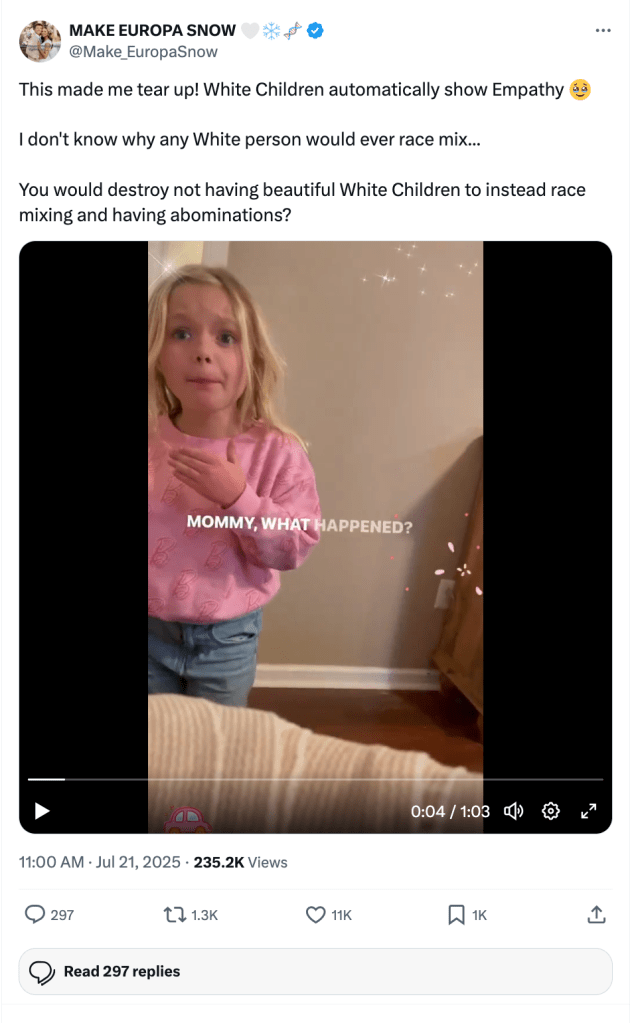
Published 21 July 2025
*See link below for full video
https://x.com/make_europasnow/status/1947340929792414212
Elon Musk’s X.com, formerly known as Twitter, was once regarded as a vital platform to connect journalists to their audiences, public safety officials to the affected public, and creators with their fans and viewers. More often than not utilitarian, this platform, un-flashy, with its slate white (or dark mode) layout, simple text, hyperlinks, hashtags, the occasional image, and a strict 140-character limit, demanded the attention of both the powerful and those simply wanting to remain in the know. Because of its usability for both creators and viewers, its informal aesthetic, and its communal atmosphere, Twitter was a place of connection most broadly. These days, however, it’s simplicity, straightforwardness, and unassuming aesthetic work towards a more divisive end.
There are a lot of reasons for this change in its content, many notable and important simply didn’t make the cut to be included in this blog post. Many reasons are the least bit exclusive to X. With the return of the laissez-faire M.O. when it comes to censoring radicals, especially those with right-wing and blatantly fascist politics. X is far from alone in choosing to privilege one and censor another select set of beliefs that are agreeable to their corporate ideology; in the reverse, see Meta’s censorship of pro-Palestinian content. Since the takeover of Twitter by billionaire Elon Musk (in turn creating X.com), the platform has walked back its banning of many influential far-right, albeit fascist and hateful posters, notably, conspiracy theorist Alex Jones and out-and-about white nationalist Nick Fuentes, to name a few.
In the post above, shared by @Make_EuropaSnow, the partial caption “White Children automatically show empathy 🥹” is set against a TikTok/ Instagram Reel-type short-form compilation video of children comforting their family members. To begin, it begs the audience to equate whiteness with empathy, taking this video from its original context, whatever it may be, and placing it under a message promoting anti-miscegenation and white supremacy. A cute compilation of children doing things children do becomes a political tool, a prop, to promote a separatist, hateful ideology based on both the prospective identity of the viewer and the identity of these children.
This post and others like it from @Make_EuropaSnow rely on a pathos-ridden plea, the call of reflexivity upon the viewer. (Giddens, 1991) It begs the viewer to empathize with its white supremacist message while using contextless video as logos to trust their presumptions. This post, like every post we encounter online, invites its viewer to re-examine their position in the world broadly. To quote from Giddens, it “calls into perspective self-identity as a coherent phenomenon and presumes the narrative as explicit.” (Giddens, 1991) It asks the viewer to relate to its ideology using an abducted video to serve as evidence in its case. This post, regardless of whether one sympathizes with or scorns it, asks its reader to practice self-observation: “Am I for or against this and why? Is my identity somehow tied to this, and should I rethink my position on it?”
This triggering of self-observation is what makes these posts either unappealing or appealing to some, @Make_EuropaSnow, and countless other anonymously popular accounts like it, constantly question the viewers’ held beliefs surrounding their identity. When looking at this post under a microscope, we can gawk at its straightforward racism and dismiss it as shitposting, but look again… it has almost twelve thousand likes and over one thousand re-posts.
This content is point-blank salient, and for reasons that are more than obvious if you take into account the persistence with which these messages are posted, shared, deliberated, and agreed with. If we are all being asked to question our agnostic, or hopefully, anti-racist beliefs day in and day out, does this not, over time, change some perceptions of self-identity and manufacture more and more consent for the public to harbor dangerous beliefs?
Dylan J Raskay
(Written: 25 September 2025)
 Disregarded Opinion News
Leave a comment